

Originally developed in gerontology and medical training, ageing simulation suits have gradually become essential tools for awareness, product design, and innovation. From scientific research to industrial applications, they help people better understand age-related limitations and adapt products, services, and environments to the realities of an ageing population. Here’s an overview of their evolution and impact.

How Did Ageing Simulation Suits Originate?
Ageing simulators emerged primarily from the fields of gerontology—the study of ageing—and medical education during the 1970s and 1980s. The earliest known age simulation experiment dates back to 1970 in a German geriatric clinic. Medical students were asked to wear cream-coloured glasses coated with petroleum jelly to blur their vision, weights on their arms, and rubber bands between their legs to mimic restricted mobility.
Today, ageing simulators typically reproduce several complementary dimensions of ageing in order to create a realistic experience of the physical limitations associated with later life. These include:
- Vision, Specialized goggles can simulate conditions such as cataracts, glaucoma, and age-related macular degeneration (AMD), reducing visual acuity, narrowing the field of vision, and limiting contrast perception.
- Hearing, Hearing-loss simulation systems reproduce the altered perception of sound frequencies that often accompanies ageing. Since age-related hearing loss does not affect all frequencies equally, these systems can recreate the muffled or distorted sounds commonly experienced by older adults.
- Mobility, Orthotic devices, weighted components, and exoskeleton-like restrictions limit joint movement, increase stiffness, and simulate muscle weakness, making everyday movements slower and more physically demanding.
Aging simulators: long-standing tools designed to meet the needs of older adults
Ford’s “Third Age Suit”
Ford Motor Company played a significant role in popularizing ageing simulation technology during the 1990s with the development of its “Third Age Suit.” The goal was straightforward: allow engineers to experience the physical limitations faced by older adults in order to design vehicles that were more accessible, comfortable, and user-friendly. The suit simulated:
- Joint stiffness
- Reduced vision
- Decreased strength
To achieve this, it incorporated weights to mimic muscle weakness, restrictions around major joints, and glasses designed to reproduce common visual impairments.
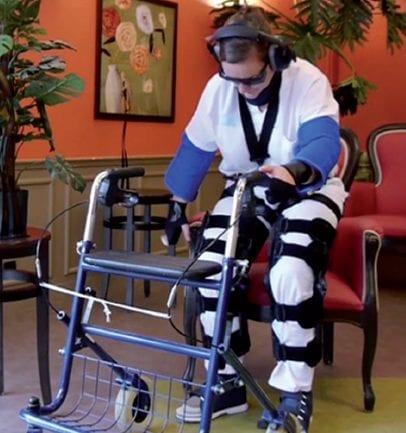
The “Senior Suit”
Between 1992 and 2002, Dr. Schoeffel, founder of SD&C, worked at Siemens studying the functional limitations older adults encountered when using everyday products. His objective was to create products that could be used comfortably by both seniors and younger generations. He developed the idea of using ageing simulators as a faster and more cost-effective alternative to traditional user testing. Beginning in 1999, he shifted his focus toward simulating the normal functional declines associated with ageing rather than geriatric diseases.
Working in collaboration with the University of Kiel, his research was scientifically validated and contributed to academic publications, patents, and guidelines that later influenced ISO standards in ergonomics and universal design. From 2003 onward, SD&C expanded the use of these simulators beyond product development, employing them as awareness tools for businesses and the general public. Insights gathered from thousands of user experiences helped refine subsequent models, including the well-known “Senior Suit.”
The “Age Explorer”
In 2002, the French newspaper La Dépêche reported on an ageing simulator known as the “Age Explorer.” Developed by the German consulting firm Meyer-Hentschel, based in Saarbrücken and specialized in ageing-related research, the simulator took the form of a cotton suit equipped with six kilograms of strategically placed weights, a helmet with a yellow-tinted visor, and oversized earplugs.
The suit combined weighted elements, joint restrictions, visual filters, and hearing impairments to realistically reproduce many of the challenges associated with ageing. Its primary purpose was educational and ergonomic: helping designers, manufacturers, and healthcare professionals better understand the needs of older adults. Used by thousands of participants from both industry and the social sector, the Age Explorer became a major awareness-raising tool. It highlighted the very practical difficulties encountered in daily life—mobility, vision, hearing, and object handling—and influenced the growing adoption of accessibility-focused and age-inclusive design practices.
Where Are We Today?
Ageing simulators have long since moved beyond their original role in research and product development. They are now widely recognized as powerful educational and experiential tools, particularly within gerontology and healthcare training
- In the training of healthcare providers and medical students, these suits go beyond theoretical knowledge by offering a firsthand understanding of the effects of aging. By simulating sensory and motor limitations, the suits foster greater empathy toward older patients, as well as more nuanced adjustments to professional practices: slower communication, increased vigilance regarding fall risks, and consideration of fatigue and pain in caregiving tasks.
- At the same time, their use in raising public awareness addresses a critical societal issue: changing perceptions of aging. By allowing everyone to experience, even briefly, the challenges of old age, these simulators help break down certain stereotypes and foster a better understanding of the difficulties faced in daily life. They thus serve as a powerful tool for promoting more inclusive environments—whether public spaces, services, or products—in the context of an increasingly aging population.
The French company ReSanté-Vous offers Scenésens, an educational kit designed by gerontology professionals with a commitment to social responsibility. Like its predecessors, this tool allows users to experience and better understand the motor and sensory challenges faced by older adults, “to adapt both their professional practices and their civic engagement.”
Another system known today is the suit called GERT (Gerontological Test Suit), developed by the German company Produkt + Projekt Wolfgang Moll in the 1990s. This type of suit incorporates weights, special goggles, and joint restraints to simulate the effects of aging.
Published by the Editorial Staff on